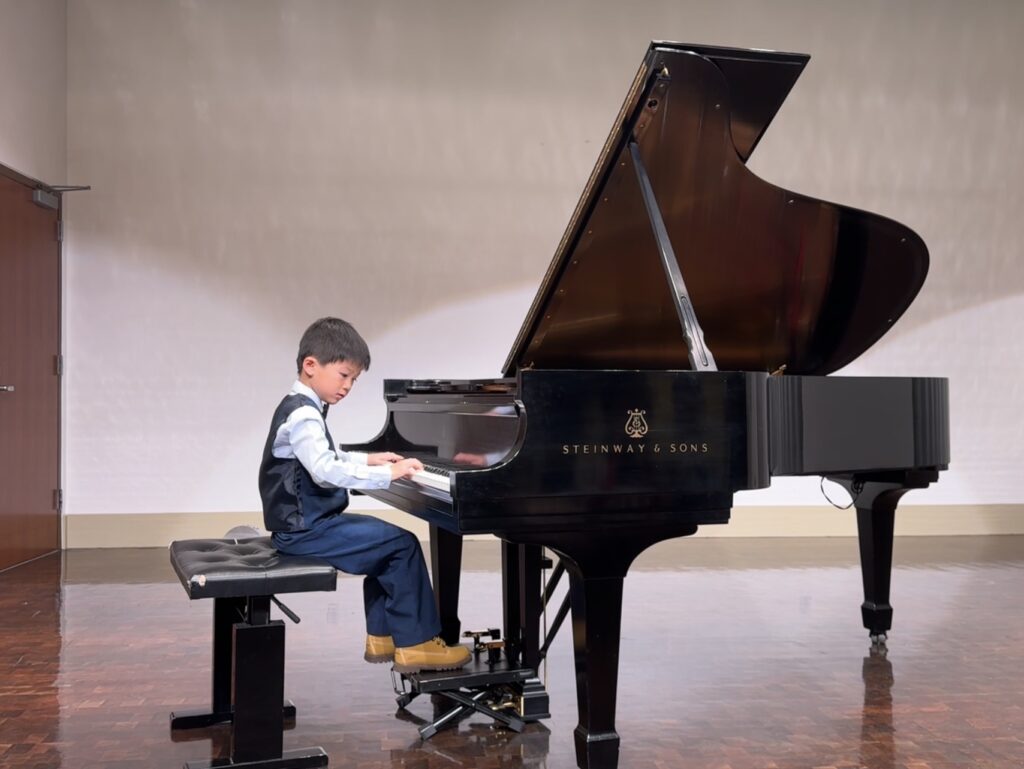
2027 Adjudicator Showcase Masterclass & Concert: Dr. Ilya Blinov plays Tchaikovsky’s The Seasons

Date and time: Sunday, February 21, 2027,
Concert time: 2:15pm – 3:30pm
Masterclass time: 4:00pm – 5:30pm
Venue: Berkeley Piano Club, 2724 Haste St., Berkeley CA 94704

Admission: Free and open to the public
Masterclass participants: the three First Place Winners from the Showcase Piano Solo events and two Alternate Winners.

The 2027 Adjudicator Showcase pairs a masterclass and a concert with pianist Dr. Ilya Blinov, our Coordinator of Adjudicator. Both are free and open to the public.

The Concert

The program is Tchaikovsky’s The Seasons: twelve character pieces, one for each month from January to December. Tchaikovsky wrote them for a St. Petersburg music magazine, which published one piece each month through 1876. In Russia the set is a staple of the piano repertoire. In the US it is far less familiar.

“I’d like to change that,” Dr. Blinov says. “How do Russian seasons compare to those in California? When it comes to winter, it’s obvious. But what about the other three? How are they different or similar? How did Tchaikovsky portray them? And how should we play this music, living in a land of eternal summer?”

The Masterclass

Dr. Blinov will work with five students in front of an audience: the three First Place Winners from the Showcase Piano Solo events and two Alternate Winners. All five receive monetary prizes. Format: each student performs a piece, then works with him

He remembers what it was like to be on the other side. “Being a student in a masterclass is nerve-racking. I remember working with Menahem Pressler and Ingrid Fliter in front of a full house. You feel so exposed! My advice: try to forget about the audience, and do your best to absorb a new perspective on a piece you’ve been playing for a long time.”

Participants can expect to hear him return to one idea in particular. “Music is sound in motion. Most students forget the second part of that equation. How the music moves can drastically change the character of a piece. It’s so exciting to change a lot by doing a little.”

Dr. Blinov is a Russian-American pianist based in the Bay Area, with a DMA from the University of Michigan and performances in Rome, Paris, and Detroit.
Meet Dr. Ilya Blinov, Coordinator of Adjudicators

Dr. Ilya Blinov is a Russian-American pianist based in the San Francisco Bay Area. At the 2027 USOMC he serves as Coordinator of Adjudicators and as an adjudicator, and he closes competition week with the Adjudicator Showcase Masterclass & Concert.

Dr. Blinov trained in Russia at the Nizhny Novgorod State Conservatory. He then came to the United States, where he earned a Master of Music at Bowling Green State University and a Doctor of Musical Arts in piano performance at the University of Michigan. He has performed at the Accademia Nazionale di Santa Cecilia in Rome, the Yamaha Center in Paris, and the Max M. Fisher Music Center in Detroit.

He is known for the illuminated recital, a format that pairs music with narrative and visuals. The storytelling comes naturally to him: before moving to the US, he published more than a hundred articles and reviews as a music critic for Nizhny Novgorod News. He began teaching in Nizhny Novgorod in 1993 and has since taught at the University of Michigan, Bowling Green State University, Interlochen Arts Camp, and Susquehanna University, with students ranging in age from 5 to 83.

You trained in Russia and earned your doctorate in Michigan. How did you get here?After I finished all the steps of my musical training in Russia (school, college, conservatory, postgraduate, about 20 years in all), I decided to see what the US had to offer. First I was admitted to Bowling Green State University for a Master’s program, and then I was lucky enough to study at the University of Michigan for my Doctorate.
Your recitals combine music, narrative, and visuals. Where did that idea come from?One of my teachers in Russia, Elena Dutlova, always included narrative in her studio recitals. We kids didn’t just play. We listened to what she had to say, and each of us was asked to contribute a sentence or two before playing our pieces. Her recitals were always a success. My illuminated recitals grow out of her idea of connecting the audience more closely with the music.
What does good adjudicating look like? What are you listening for?Most of the music we perform has withstood the harshest test possible, the test of time, precisely because it allows countless interpretations. There’s no single correct way to play a Bach prelude or a Beethoven sonata. Once the major technical issues are resolved (the pulse is organized, the balance makes sense, the pedal is listened to, and so on), all that matters is what the pianist sees in the piece. What is important to him or her? It is fascinating to hear unique approaches to familiar music.
Competitions are high-pressure for young musicians. What do you hope students take away, whatever the outcome?My students and I talk about competitions and what they offer a young musician. The most obvious benefits are the drive to do your very best, the test of performing under pressure, and the chance to see what your peers are doing. Last year, one of my students said something I didn’t expect to hear from a 10-year-old: “I learned how not to fall apart if they don’t call my name among the winners.” What a profound idea! Think how often in life you won’t get what you wanted and worked hard for. Learning to deal with that is a very important skill.
What does the Bay Area music community mean to you, and why did you say yes to USOMC 2027?I moved to the Bay Area in 2017, so 2027 marks ten years here. It’s a unique place for a young pianist and a piano teacher. I have lived and worked in Ohio, Michigan, Illinois, Pennsylvania, and New York, and the Bay Area leaves all those great states way behind in its hunger for learning the piano and playing the great music written for it. USOMC brings that passion to a highly concentrated level. To me, it’s like having another Christmas in February!
Anything you’d like to say to the students competing this year?The last five minutes before you step onto the stage are the scariest time imaginable. But once you take a bow and begin playing, it actually gets better. Remember that during those horrible five minutes. And remember that the judges who look so intimidating behind their desks know all about those five minutes, and they want you to do well.

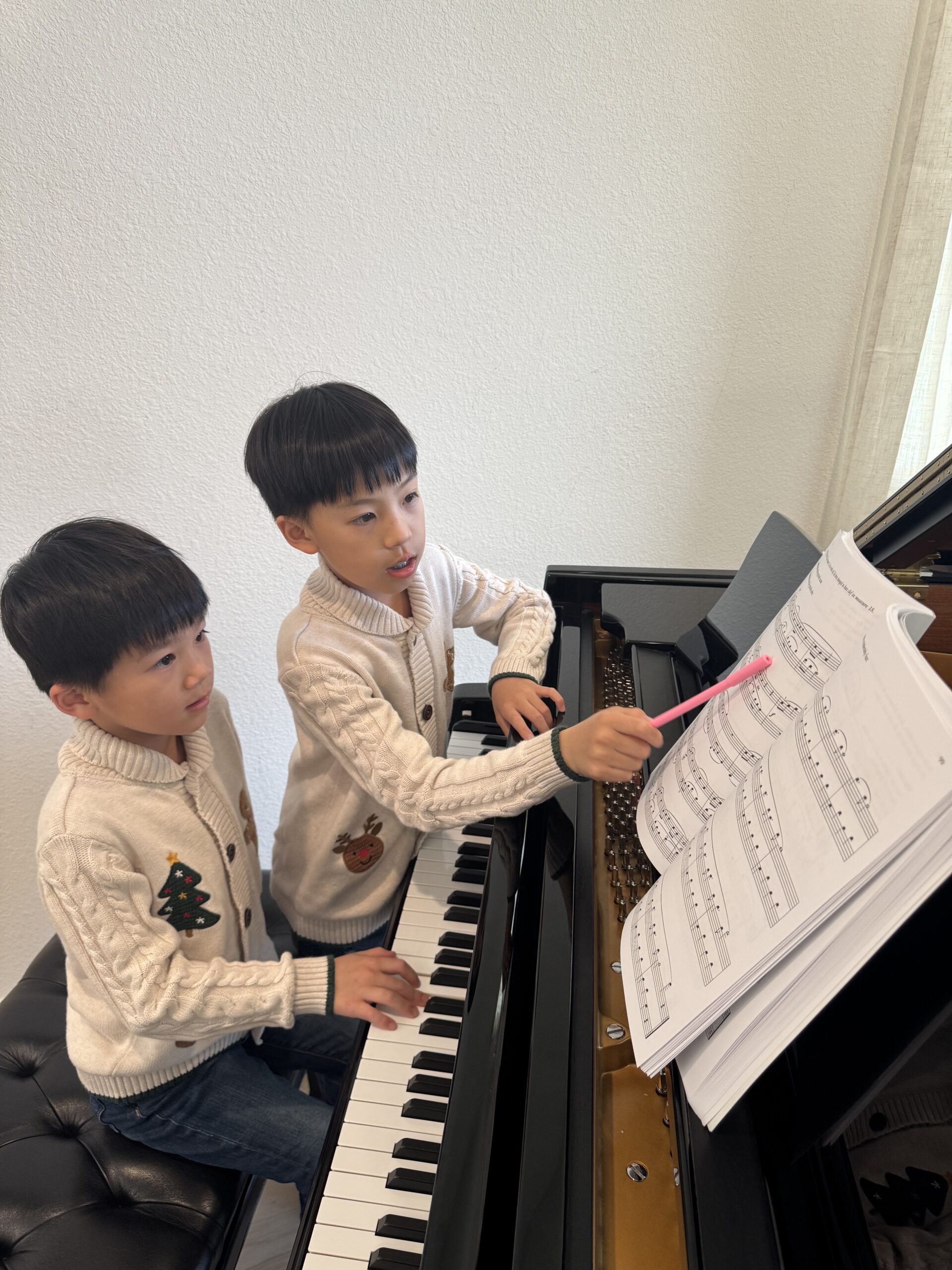
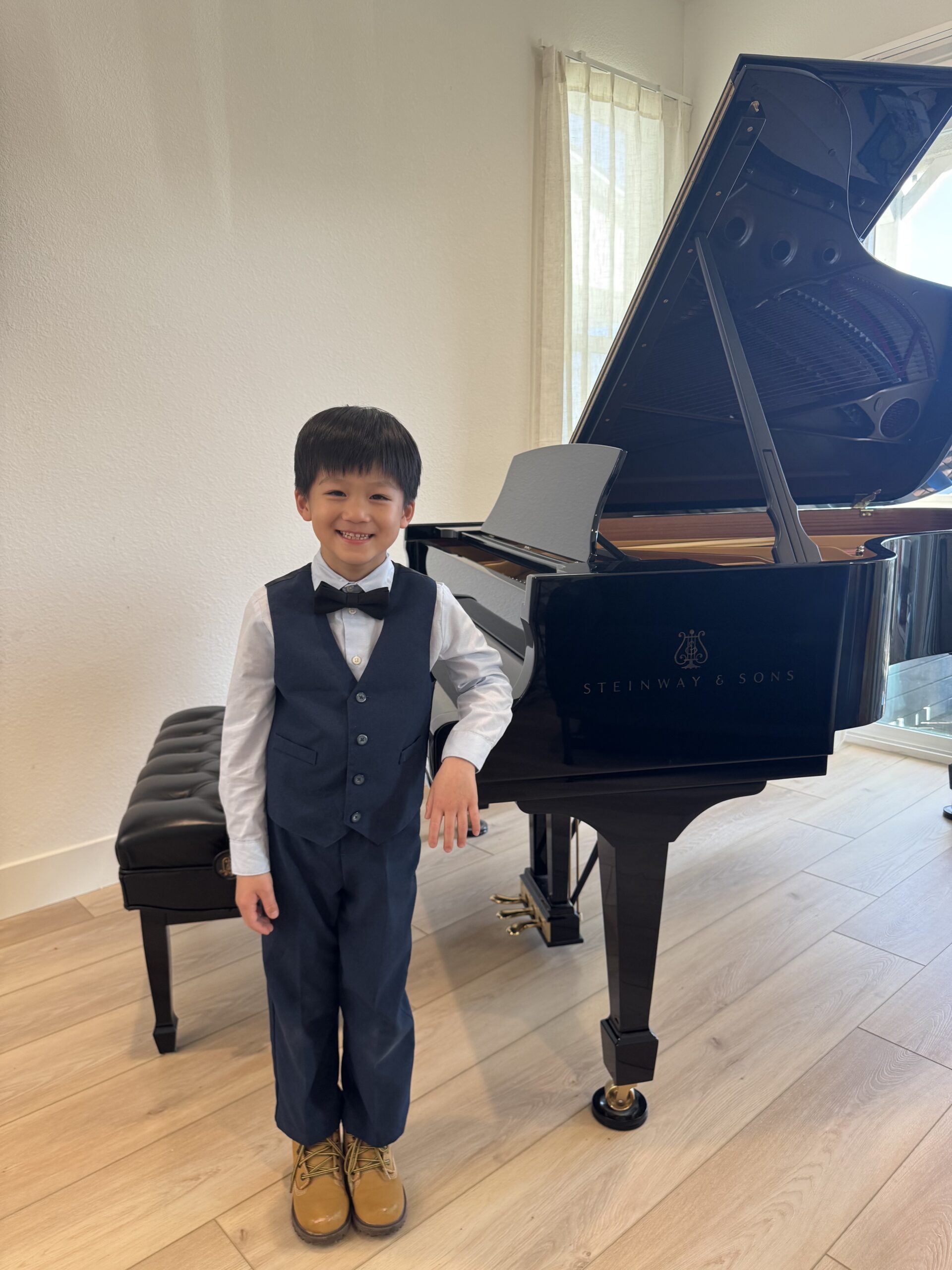
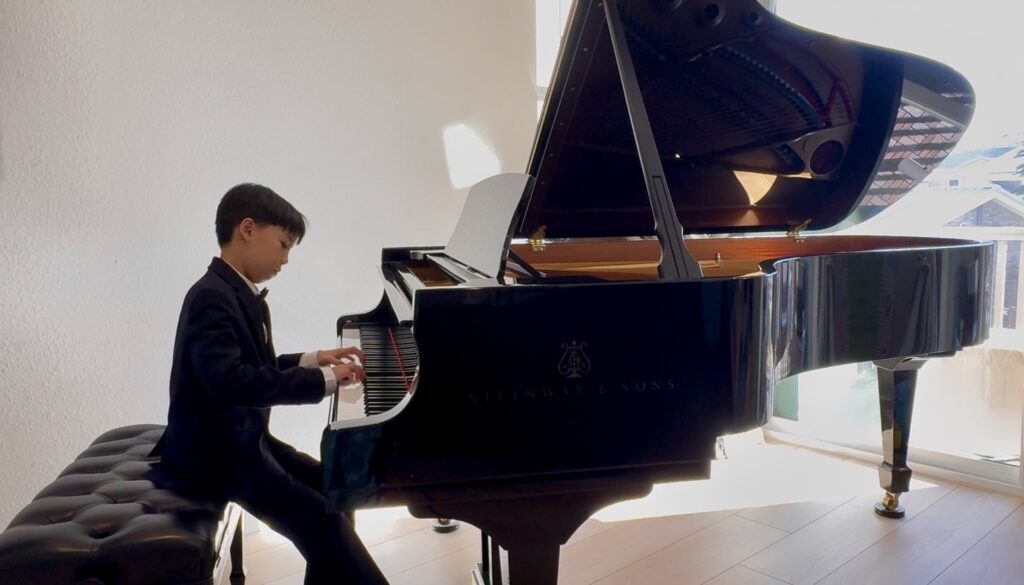
Growing with Music: Kevin and Ethan’s Journey at the Piano

Submitted by Jenny Luo

Published on 4/17/2026

Kevin’s connection with music began long before he formally studied
piano. As a toddler, he was naturally drawn to children’s songs,
listening with surprising focus and attentiveness. Music seemed to
capture him in a quiet but powerful way.

As he grew older, his curiosity expanded across different styles. At
one point, he became fascinated with Michael Jackson. He would watch
performances repeatedly and eagerly imitate the rhythm and movement.
Even then, music was not something he simply listened to — it was
something he felt and expressed physically. That early sense of rhythm
and energy later became part of how he approached the piano.

When we brought home an electronic keyboard, he began experimenting on
his own. Seeing his growing interest, we eventually enrolled him in
formal piano lessons.

After studying piano for some time, we began to notice something
remarkable. As his training progressed, his listening became
increasingly precise. When he heard a melody, he could often identify
the exact pitch of individual notes without touching the keyboard.
Over time, he began recreating some melodies by ear with striking
accuracy. It became clear that he was not only learning to play music,
but learning to truly hear it.

As his technical foundation strengthened, his appreciation for
classical repertoire grew significantly. He became especially
fascinated by works such as Liszt’s La Campanella and many of Chopin’s
nocturnes. What moves us most is not simply that he enjoys these
pieces, but that he tries to understand their emotional character.
When playing Chopin, he often reflects on the delicate, nuanced
feelings within the music and attempts to communicate that sensitivity
through phrasing and dynamics. We have watched him grow more
thoughtful and expressive with each new piece.

The journey, however, has not always been smooth.

There have been moments of frustration when progress felt slow. Kevin
is sensitive and reflective; when a passage proves difficult, he
sometimes becomes deeply discouraged. Sometimes he has stepped away
from the piano in tears. As parents, those moments have not been easy
to witness.

Yet what stands out most is what follows.

After the frustration, he returns to the piano on his own, ready to
try again. That quiet determination — choosing to persist — has meant
more to us than any single accomplishment. Through music, we have seen
him develop resilience, patience, and emotional maturity.

Ethan’s journey has unfolded naturally alongside his older brother’s.
From a young age, he loved to sing and hum melodies around the house,
listening closely whenever Kevin practiced. Inspired by his brother’s
dedication, he too developed a genuine interest in learning the piano.
Music has become part of the rhythm of our family life.

For us, the most meaningful part of this journey is not awards, but
growth — seeing curiosity develop into discipline, sensitivity deepen
into expression, and practice transform into confidence. Music
continues to shape not only their skills, but their character.

President Lamae Loo receiving the CBS Bay Area Icon Award

Exciting news! We’re incredibly proud to share that our Co-founder and President, Lamae Loo, has been honored with the CBS News Bay Area Icon Award! Huge thanks to KPIX-TV and Sharon Chin for recognizing her decades of dedication to music education and inspiring young musicians. This is a beautiful tribute to her lasting impact that she has had in our community!

To see the full story, please click on the link here: https://www.cbsnews.com/sanfrancisco/news/east-bay-piano-teacher-uses-competition-to-inspire-students/

USOMC Giving back to the Community Program

In 2014, the Board of Directors of the USOMC, established, The USOMC Giving Back to the Community Program in order to further advance the love of classical music among the youth.  By means of sponsoring young people deserving encouragement in their serious pursuits of music instruction and training, the USOMC is endeavoring to widen its positive influence among young musicians.

Organizations which share the same vision and cause as the USOMC will, also, be eligible for grants from The USOMC Giving Back to the Community Program.

Participants and attendees of the 2015 USOMC have an opportunity to contribute to The USOMC Giving Back to the Community Program.

All proceeds from personal greeting messages and commercial ads on the USOMC mobile web page shall go to The USOMC Giving Back to the Community Program.

USOMC goes Mobile

United States Open Music Competition goes mobile United States Open Music Competition (USOMC) is a non-profit organization promoting classical music to young people. Annually, USOMC hosts a competition event and invites young musicians around the globe to participate. For the year 2014, we had over 1300 contestants participate in over two thousands events. On top of the awards for the winners of each event in the competition, USOMC also granted scholarships to qualified individuals for the continuation of their music studies. USOMC started this mission 22 years ago in 1992. I am a volunteer and vice president of this organization. Up until 2 to 3 years ago, USOMC operations had been mostly a manual process. (Musicians are not necessarily tech savvy.) A few months back, when I was elected to a vice president, I started to look into modernizing the whole operation of communications. One thought that jumped into my mind was using mobile apps to communicate information. Throughout the week long competition, our information booth would always be flooded with contestants asking questions, from, “Where is my event being held?”, “Where will I get my award?” to, “How may I claim my award?” One solution that came to my mind was to make a mobile app and make answers to these kinds of questions available. Simple, but a “big deal” for the USOMC organization. I, myself, know a little bit about programming, but certainly I will not have the time to do a full scale java or python programming. So, I set out to search for a tool, and I came across Appery.io. I was completely attracted to it by the ease of use. For most applications, I could just easily rely on drag and drop and I would be done. In many parts, I will just need a little JS programming, but never more than 10 lines long. This the beauty of it for an organization like USOMC, which does not have huge IT budget. As a prototype, I decided to try out the two most commonly asked questions: ”What is my event? and “Where is my event?” Within a day (yes, seriously), I already had an app that will accept the contestant’s name and list all his the events. Clicking on individual event, the app will lead him to a detailed page. Wow! I demonstrated this app to the board and it absolutely blew their minds. We decided that we woul make this app to be the official USOMC event mobile app. I think we are done with this year's app enhancements, but we just have so many different ideas for next year, and I will continue to rely on Appery.io's ease of use, but yet with powerful out-of-the-box components to finish my job. Thank you Appery.io(http://appery.io)!  Try out our mobile web from here.

Raymond Pak
Vice President, USOMC